Reducing Academic Stress Through Co-Watching: The Role of Shared Streams and Party Gaming in Modern Student Socialization
 0
0
 0
0
Burnout doesn’t announce itself. It tends to arrive quietly, somewhere around week seven of semester, when you’ve cancelled on three social things in a row and your flatmates have stopped knocking on your door because they already know the answer.
For a lot of students right now, the stress isn’t just academic — it’s the particular loneliness of being surrounded by people but feeling completely untethered from them. Libraries are full. Lecture theatres are packed. But actual human connection? That’s the thing quietly running out.
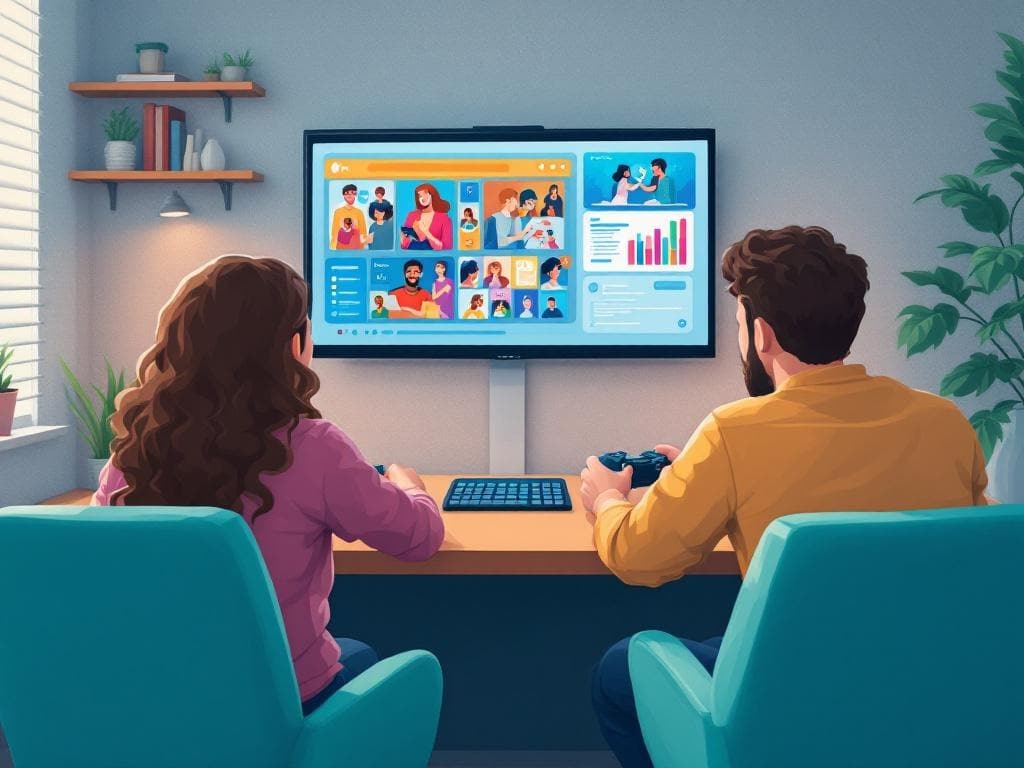
What’s emerged in response isn’t some app-backed wellness programme or a university counselling initiative (though those matter too). It’s something much more informal: students watching things together, playing things together, over shared screens. Co-watching and party gaming. Genuinely communal digital experience. And there’s more going on there than it first appears.
The problem with “just relaxing”
Telling a stressed student to relax is a bit like telling someone with a broken leg to walk it off. The advice isn’t wrong, exactly. It’s just useless without context.
The issue is that passive, solo relaxation — lying in bed doom-scrolling, watching something alone at 1am — doesn’t actually restore the social energy that academic stress depletes. Research from Otago and Auckland universities has pointed toward this for years: students who feel a sense of community and shared experience report significantly lower stress and better academic outcomes than those who are socially isolated, even when workloads are identical.
Here’s the thing — unwinding works better when someone else is there. Not talking, necessarily. Just present. That low-level background hum of another person being with you in something, even something as inconsequential as watching a reality TV show, activates a kind of social restoration that solo screen time simply doesn’t.
What co-watching actually looks like in student flats
In practice, it’s pretty unglamorous. Someone has a Disney+ or Netflix account, someone else has the good TV in the lounge, and by 9pm on a Wednesday there are four people in mismatched socks arguing mildly about whether to rewatch Severance or give something new a go.
That’s the whole point. The friction of negotiating what to watch, the commentary that runs through it, the mutual horror at a plot twist — this is social bonding that doesn’t require anyone to perform being okay. You’re not at a party where you need to have answers about your future. You’re just watching television with people you live with.
Teleparty (formerly Netflix Party) and similar browser-sync tools have extended this further, letting students co-watch with flatmates who’ve gone home for the holidays or friends at other campuses. It’s not quite the same as the couch, but it’s surprisingly close. The chat sidebar becomes its own little social space. You find out things about people through how they react to fiction that you’d never learn in a normal conversation.
The quiet social function of party gaming
Party gaming — things like Jackbox, Among Us, Overcooked, Stardew Valley co-op, even Mario Kart if someone has a Switch — does something slightly different from co-watching. It creates low-stakes competition and collaboration in a structure that doesn’t resemble uni at all.
There are no grades. There’s no correct answer being marked. If you make a terrible choice in Quiplash, everyone laughs including you, and then it’s gone. For students who are genuinely afraid of failure in their academic work — and that fear is more common than most people admit — this is a meaningful psychological relief valve.
Jackbox games in particular have a social architecture that’s almost sneaky in its effectiveness. The games are designed to reward personality over skill, which means a first-year who just arrived from Taranaki and knows no one is on the same footing as a fourth-year who’s played a hundred times. That’s an unusually level social playing field, and it makes genuine introductions happen naturally.
It’s not therapy, and it’s not supposed to be
Worth being clear about something: none of this replaces actual mental health support. If you’re in a dark place, watching The Bear with your flatmates is not the intervention you need. University of Auckland’s Student Mental Health services, Massey’s counselling team, and the broader Student Health networks exist for a reason — and the waitlists, while frustrating, are worth joining.
But co-watching and party gaming operate in the space below crisis level, which is where most students actually live most of the time. Stressed, a bit overwhelmed, maybe slightly behind, but fundamentally okay — and in need of connection more than intervention. That’s a huge population of people who don’t necessarily need a counsellor but who absolutely need to not spend Friday night alone staring at their own ceiling.
The maths isn’t always this clean, of course. Some people find group activities exhausting regardless of format. Some flatting arrangements are more tense than warm. And not everyone has a flat at all — plenty of students are in university halls where the social dynamics are their own complicated thing.
The whanau effect — collective restoration
There’s a framing in te ao Māori that sits comfortably around this: the idea that wellbeing isn’t individual. That you restore yourself through connection with others, not in spite of it. Whanau as a model of support isn’t just about family in the nuclear sense — it’s about people who are in it together, who share experience and carry each other through it.
The student flat, at its best, is a rough approximation of that. You’re not related. You might not even like each other all the time. But you’re sharing a fridge and a stress level and a shared social context, and at 9pm on a Wednesday night, you’re watching the same screen. That has value.
Students who come from Māori or Pasifika communities often talk about this less as a discovery and more as a continuation — extended family households have always been built on shared activity and collective presence rather than individual retreat. The idea that you sit together and watch something together is just… normal. The rest of the student population is basically catching up.
The actual cost of making this happen
Let’s be real for a second. Streaming costs money. A standard Netflix account sits around NZ$22–$26 a month depending on the plan. Disney+ is around $16–$20. If you’re a student on a StudyLink allowance trying to make rent in Auckland or Wellington, that’s not a trivial amount.
Most students split these across flatmates, which brings the per-person cost down significantly. Sharing a single account between four or five people — while technically in tension with platform terms of service — is one of those things that happens constantly and nobody serious seems to be losing sleep over. Pak’nSave can’t help you with your streaming bill, but they can help you fund the snacks, which is arguably the more important part of a good co-watch night anyway.
Free options exist too. YouTube has a ridiculous amount of legitimate long-form content. Kanopy is available free through most New Zealand public libraries and many university libraries — genuinely good films, no subscription required. Twitch is free. Discord’s Watch Together feature works with YouTube and is free. None of this needs to be expensive to work.
When screen time becomes an avoidance strategy
There’s a counterpoint that deserves space here: co-watching and party gaming can also be extremely efficient ways to avoid doing the assignment that’s due on Thursday. And unlike solo procrastination, group procrastination has a social momentum to it that’s harder to break.
One more episode becomes three more episodes. The Jackbox session that was meant to end at ten is still going at midnight. Everyone in the flat is complicit, everyone is quietly tired, and somehow no one is willing to be the one who calls it.
This is the tension that’s honestly just part of student life, not something with a neat fix. What helps is treating these shared evenings as intentional social restoration rather than ambient background activity — something you choose, have, and then put away, rather than something that swallows the whole night by default. That’s harder than it sounds when you’re already tired and the next episode autoplays in fifteen seconds.
What students are actually saying
Talk to students doing this regularly and a few things come up consistently. The first is that it removes the pressure of conversation. You don’t have to be interesting or funny or have news to share. The show is doing the heavy lifting, and you’re just there alongside it with people you like.
The second is that the shared reference points it creates carry forward. Having watched the same thing, reacted the same way to something, argued about the same character — those become connective tissue in a friendship or a flatting relationship. Months later, someone quotes a line and everyone knows exactly what episode it’s from and exactly where they were when they watched it. That’s not a small thing.
The third thing, which people say more carefully, is that it helped them realise they weren’t doing as badly as they thought. Somewhere in the middle of watching something together, the narrative they’d been running in their head — that everyone else was coping fine and they were uniquely struggling — quietly falls apart. Everyone is tired. Everyone has that essay. The shared screen makes the shared experience visible.
Making it a habit rather than a highlight
The students who seem to benefit most aren’t the ones who have one legendary co-watch night per semester. They’re the ones who’ve made something regular out of it — a loose Wednesday night ritual, a recurring gaming session on Sunday evenings before the week kicks off, something low-key enough that it doesn’t require advance planning or a specific mood to show up for.
Regularity matters because stress is regular. It doesn’t arrive once and then leave. It accumulates. So the reset needs to be built into the rhythm of the week rather than reserved for special occasions.
That’s actually it, when you strip everything back. Students who feel less isolated during high-stress periods aren’t necessarily doing anything radical — they’re just making sure there are moments in the week that belong to connection rather than productivity. And sometimes that looks like a lounge full of people in mismatched socks watching television together, which is fine, actually. That’s plenty.